The apostrophe has two functions: to show the omission of a letter or letters, and to indicate possessive case.
The all too common practice of using an apostrophe to denote a plural is to be deplored. Potatoes and tomatoes are not potatoe’s and tomatoe’s. Nor should the Mexican daisies in a florist’s shop be Mexican Daisy’s, whoever she might be. I once had a jar of Black Olive’s in my pantry, and such is the power of the apostrophe I wondered if I ought to return the jar to Black Olive. This practice of throwing apostrophes around in the supermarket is known facetiously as ‘the greengrocer’s syndrome’. I’d be inclined to call it ‘apostrophobia’ — a fear of sinning by omission!
Plurals need an apostrophe only to show possessive case, for example: ladies’ day, babies’ cots, jockeys’ colours, in which cases the apostrophe is placed after the s.
What precedes the apostrophe has to be a word. Therefore sheeps’ wool is incorrect, for sheeps is not a word. Babie’s cots is also wrong, for babie is not a word. Names that end in s sometimes present a problem. Should we say the Jone’s house, the Jones’ house or the Jones’s house? If Mr Jones has a house, it is Mr Jones’s house. Similarly, boss’s privilege (singular possessive) and bosses’ men (plural possessive).
The apostrophe is unnecessary in contractions such as 90s and 1990s, where nothing has been omitted. In other contractions such as he’ll, should’ve, comin’ and goin’, the poetical e’er, o’er and ne’er (ever, over and never), and when is or are become reduced to s or re, for example: he’s, it’s, that’s and you’re, they’re, we’re, the apostrophe is used to indicate an omitted letter or letters.
If the addition of an extra s creates too much sibilance (a hissing sound), it may be omitted from long possessives such as Aristophanes’ dramas.
What is an Apostrophe?
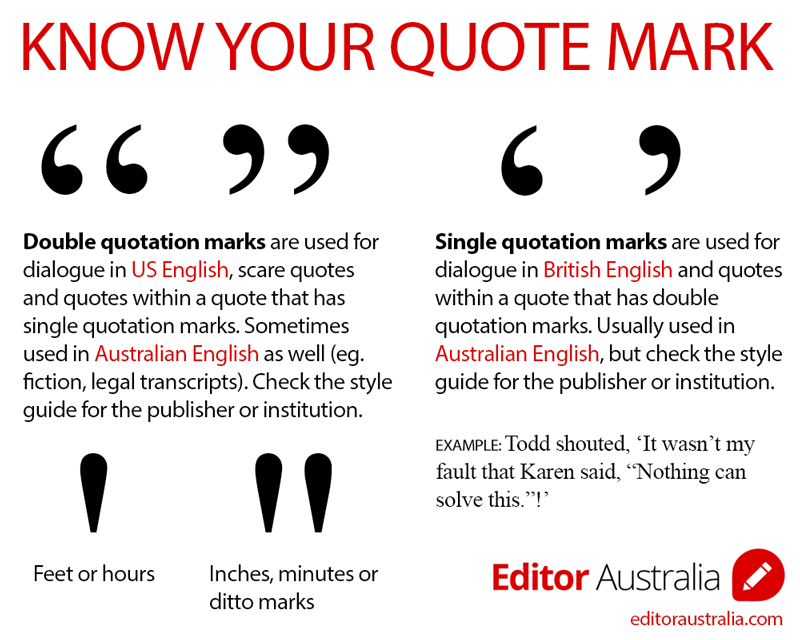
An apostrophe is the same character as a single right quotation mark, but its function is very specific. Apostrophes signify either (a) missing letters or numerals or (b) ownership/possessive.
Example A
Don’t touch that.
I haven’t had breakfast.
Example B
That is the dog’s bone.
Eileen’s mother’s step-sister took me in.
Examples of both A and B
‘That’s ’nuff now!’ he warned.
‘Let’s rock ’n’ roll!’ she whooped.
Read more about Quotations and Quotation Marks in Australian English.
Some other scenarios apostrophes should be used in
- Decades—when abbreviating decades of time use apostrophe before words like ’60s and ’80s, as it makes it easier for the reader to understand by signifying the missing ‘19’. This helps to quickly differentiate the meaning of 1960s, for example, from a lady in her 60s.
- Regarding the possessive for words ending in ‘s’, my preference is to drop the subsequent ‘s’. Eg. Simon Dorris’ hat, Jesus’ disciples, Philip Goss’ record.
Apostrophes should not be used in
- Common contractions such as quake, flu, phone
- Place names (e.g. Surfers Paradise, Coffs Harbour, Clarks Summit) and street names (e.g. Princes Highway)
- Plurals of initials and abbreviations, e.g. several TVs, MPs, PhDs, MBEs
- Plurals of numbers (e.g. 100s, the 1980s, the 1800s)
Request a free quote
Please email
greensladecreations@gmail.com
Sorry, but due to scammers and spam, I am unable to share my mobile number any more. If you want to talk, please just put that request into your email and I’ll get back to you when I can.